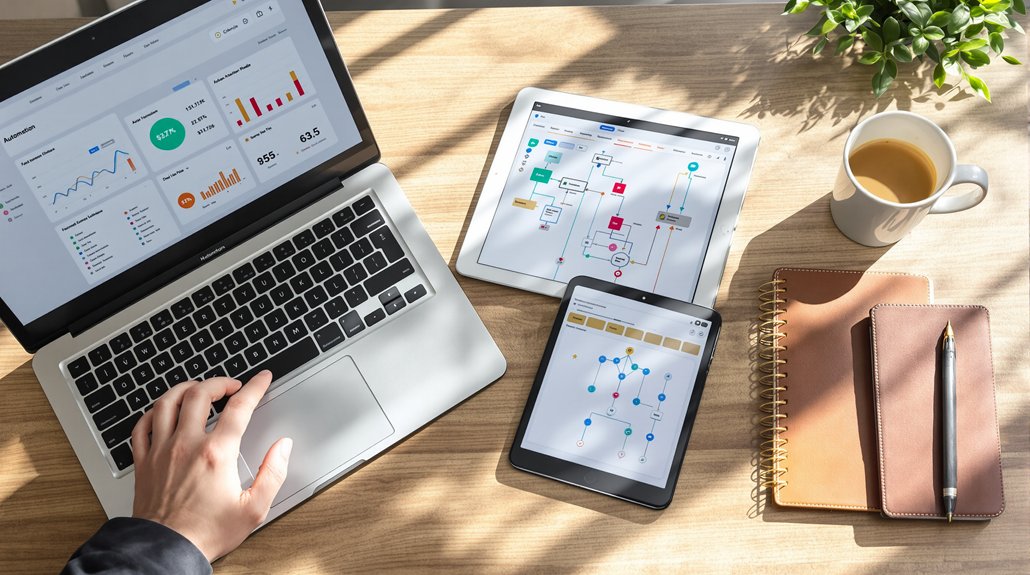
Email automation transforms your business by delivering 4X higher ROI than manual sends while freeing you to focus on growth. You’ll want to connect your CRM to your email platform for real-time data sync, then set up a three-email welcome sequence within 24 hours of signup. Use behaviour triggers to send targeted messages based on customer actions, and segment your list automatically by purchase history and engagement scores. Avoid over-automation and generic content by maintaining authentic touchpoints. The strategies below will show you exactly how to scale these systems without hiring additional staff.
What Email Automation Means for Small Business Owners

Email automation transforms how small business owners connect with customers by handling repetitive communication tasks without constant manual effort. You’ll break free from the tedious cycle of sending individual welcome emails, follow-ups, and promotional messages. Instead, you’re empowered to set up intelligent workflows that trigger based on customer actions – whether they’ve made a purchase, abandoned their cart, or signed up for your newsletter.
This technology liberates your time for strategic growth activities while maintaining consistent customer engagement. You’ll escape the limitations of your 24-hour day, as automated emails work around the clock. Your business gains the professional communication capabilities of larger companies without requiring additional staff. You’re no longer chained to your inbox, yet your customers receive timely, personalised messages that nurture relationships and drive conversions.
Why Email Automation Delivers 4X Higher ROI Than Manual Sends
When you automate your email campaigns, you’ll generate four times the return on investment compared to manually sending individual messages – and the math behind this advantage is straightforward.
Automation eliminates time-wasting tasks that trap you in repetitive work. You’ll send perfectly timed messages triggered by customer behaviour, not your availability. This precision increases conversions because prospects receive relevant content exactly when they’re ready to engage.
Automated emails reach customers at the perfect moment based on their actions, not your schedule – driving higher conversions through behavioural precision.
You’ll also scale without adding staff. Manual sending limits you to hundreds of contacts monthly. Automation handles thousands simultaneously while maintaining personalisation through dynamic fields and segmentation.
The cost difference is dramatic. Automated campaigns run 24/7 at minimal expense while manual efforts require continuous labour investment. You’re free to focus on strategy and growth instead of clicking “send” repeatedly.
Track Open Rates, Revenue per Email, and List Growth to Measure ROI
You can’t improve what you don’t measure, so tracking the right metrics is essential for understanding your email automation’s true impact. Focus on three core indicators: open rates show how well your subject lines resonate, revenue per email reveals your campaigns’ financial effectiveness, and list growth rate demonstrates your ability to expand your audience. These metrics work together to calculate your email marketing ROI and identify where to optimise your automation strategy.
Key Metrics to Monitor
Focus on three essential metrics: open rates reveal whether your subject lines capture attention, click-through rates show if your content compels action, and conversion rates measure actual business impact. Monitor revenue per email to understand profitability, and track list growth rate to gauge audience expansion.
Don’t drown in vanity metrics. Instead, establish benchmarks, test variations, and optimise relentlessly. When you measure what matters, you’ll break free from guesswork and release exponential growth through informed decisions that directly impact your bottom line.
Calculate Email Marketing ROI
Everything changes when you calculate your email marketing ROI accurately. You’ll break free from guesswork and make data-driven decisions that propel your business forward.
Track your open rates to gauge subject line effectiveness and audience engagement. Monitor revenue per email by dividing total campaign revenue by emails sent – this reveals your true earning potential. Calculate list growth rate monthly to guarantee you’re expanding your reach, not haemorrhaging subscribers.
Here’s your freedom formula: subtract campaign costs from generated revenue, divide by costs, then multiply by 100. A positive ROI means you’re winning.
Don’t settle for vanity metrics. Focus on conversion rates, click-through percentages, and unsubscribe trends. These numbers expose what’s working and what’s holding you back, empowering you to optimise relentlessly and scale profitably.
Connect Your CRM and Email Platform to Sync Customer Data
You’ll need to select integration tools that work seamlessly with both your CRM and email platform to create a unified system. Look for native integrations or third-party connectors that enable automatic, real-time synchronisation of customer data between platforms. This guarantees your email campaigns always reference the most current customer information, from purchase history to engagement preferences.
Choose Compatible Integration Tools
When your CRM and email platform work together seamlessly, you’ll eliminate manual data entry and reduce costly errors that can derail your campaigns. Break free from tedious manual processes by selecting integration tools that truly communicate with each other.
Start by verifying native integrations between your existing platforms. If they don’t connect directly, explore middleware solutions like Zapier, Make, or Workato that bridge the gap. Don’t settle for clunky workarounds that’ll chain you to spreadsheets.
Test data flow in both directions before committing. You need customer information, purchase history, and engagement metrics syncing automatically. Choose tools that update in real-time, not overnight batches.
Your integration should empower you to launch campaigns instantly, not force you into rigid workflows that stifle creativity and responsiveness.
Automate Real-Time Data Sync
Real-time data synchronisation transforms your email campaigns from generic broadcasts into precision-targeted conversations. When you connect your CRM and email platform, customer actions trigger immediate updates across both systems. This means you’re never working with outdated information that undermines your messaging.
You’ll break free from manual data entry and the errors that come with it. Instead, purchase history, browsing behaviour, and support interactions automatically flow into your email segments. This empowers you to send the right message at exactly the right moment.
Set up bidirectional sync so engagement data flows back to your CRM too. You’ll gain complete visibility into how customers interact with your emails, enabling smarter follow-up strategies that actually convert.
Set Up Your First Welcome Email Sequence in 30 Minutes
Since most subscribers decide whether to engage with your brand within the first 24 hours of signing up, your welcome email sequence can’t wait. Break free from perfectionism and launch yours today.
Start with three emails. Email one delivers immediately: confirm their subscription, set expectations, and provide one quick win – a resource, discount, or actionable tip. Email two arrives 24 hours later, sharing your brand story and core values. Email three sends on day three, highlighting your best content or products.
Use your automation platform’s template builder. Write conversational subject lines. Keep each email under 200 words. Add clear calls-to-action.
Test your sequence by subscribing yourself. You’ll spot broken links and timing issues instantly. Launch imperfectly, then refine based on open rates.
Recover Lost Sales With Automated Abandoned Cart Reminders

Nearly 70% of online shopping carts never make it to checkout, but those abandoned browsers aren’t lost customers – they’re warm leads who’ve already shown purchase intent.
You’ll capture these missed opportunities by automating a three-email sequence. Send your first reminder within one hour – strike while interest peaks. Include the product image, clear pricing, and a direct checkout link. Follow up at 24 hours with social proof or reviews that eliminate hesitation. Your final email at 72 hours should offer a time-sensitive incentive: free shipping, a modest discount, or bonus item.
You’re not pestering; you’re removing friction. Most buyers abandon carts due to unexpected costs, comparison shopping, or simple distractions. Your automated sequence breaks through the noise, reclaims revenue that’s rightfully yours, and transforms hesitation into conversion.
Use Behaviour Triggers to Send Messages Based on Customer Activity
When customers browse your pricing page three times without purchasing, click specific product categories repeatedly, or download a white paper, they’re telegraphing their intentions – and your automated emails should respond accordingly. Set up behaviour triggers that break free from generic messaging. When someone abandons a webinar registration, send targeted content addressing their specific interests. If they’ve clicked outdoor gear five times, don’t send kitchen appliance promotions. Configure triggers based on page visits, content downloads, email engagement patterns, and site navigation paths. This intelligence transforms your email system from a broadcasting tool into a responsive communication engine. You’ll stop wasting time manually tracking customer actions and start delivering relevant messages automatically. Each trigger creates personalised touchpoints that move prospects toward conversion without constant oversight.
Segment Your List by Purchase History and Engagement Level Automatically
You’ll maximise your email ROI when you automatically sort subscribers based on their spending patterns and interaction levels. Behavioural triggers can instantly move customers into segments like high-value buyers, window shoppers, or dormant subscribers, while engagement scoring systems track opens, clicks, and conversions to refine your targeting. Revenue-based list grouping lets you craft personalised campaigns for big spenders versus bargain hunters, ensuring each message resonates with the recipient’s demonstrated preferences.
Behavioural Triggers Drive Segmentation
Segmentation transforms generic email blasts into personalised conversations that resonate with each subscriber’s unique journey. You’ll break free from the one-size-fits-all approach by implementing behavioural triggers that automatically categorise your audience based on their actions.
Track website visits, email opens, link clicks, and cart abandonments to create dynamic segments that shift as your subscribers engage. When someone browses your pricing page three times, they’re signalling readiness – trigger a tailored sequence addressing their specific concerns.
You’re no longer guessing what your audience wants. Instead, you’re responding to their demonstrated interests in real-time. Set up triggers for milestone events: first purchase, repeat buyer status, or prolonged inactivity. Each behaviour tells a story, and your automated system guarantees you’re sending the right message at precisely the right moment.
Revenue-Based List Grouping
Your highest-value customers deserve different treatment than bargain hunters, and revenue-based segmentation makes this distinction automatic. Set triggers that categorise subscribers by total spend, average order value, and purchase frequency. You’ll send VIP customers exclusive early access and premium offers while directing price-conscious buyers toward sales and bundles.
Track lifetime value alongside engagement metrics. Someone who’s spent $5,000 but hasn’t opened emails in months needs a different re-engagement strategy than a $50 customer who clicks everything. Automate workflows that reward top spenders with loyalty perks and personalised recommendations based on their purchase patterns.
This segmentation eliminates the one-size-fits-all approach that kills conversions. You’re maximising revenue by speaking directly to each customer’s demonstrated value and interests.
Engagement Scoring Systems
A points-based system tracks every subscriber action – opens, clicks, purchases, replies – and assigns numerical values that trigger automated workflows. You’ll break free from manual list management by letting engagement scores automatically sort your audience into action-takers, fence-sitters, and dormant subscribers.
Set thresholds that move people between segments without your intervention. High scorers receive premium offers and exclusive content. Mid-range subscribers get nurture sequences designed to boost participation. Low scorers trigger re-engagement campaigns or list cleaning protocols.
You’re no longer guessing who’s interested. The system reveals purchasing patterns and content preferences through behavioural data. This intelligence powers personalised automation that converts better than generic broadcasts. You’ll spend less time sorting spreadsheets and more time creating campaigns that actually drive revenue.
Avoid Over-Automation, Poor Timing, and Generic Content Mistakes
While email automation streamlines your marketing efforts, it’s easy to fall into traps that’ll damage your relationship with subscribers. Break free from these common mistakes:
- Over-automation kills authenticity – Don’t automate every interaction. Your audience craves genuine human connection, not robotic responses that scream “template.”
- Poor timing drives unsubscribes – Sending emails at 3 AM or bombarding inboxes daily pushes subscribers away. Test send times and respect boundaries.
- Generic content breeds indifference – Mass-blasting identical messages ignores what makes each subscriber unique. Leverage segmentation and personalisation tokens.
- Ignoring feedback loops – When subscribers disengage or complain, your automation should adapt. Monitor metrics and adjust your strategy accordingly.
You’ve got the power to automate strategically while maintaining meaningful connections.
Scale Email Automation Without Adding Headcount or Agencies
Because most businesses assume scaling email automation requires hiring specialists or expensive agencies, they delay growth initiatives that could generate revenue today. You don’t need a team of experts to expand your automated campaigns. Modern platforms handle the technical complexity while you focus on strategy and content.
Start by creating modular email templates you can repurpose across multiple campaigns. Build automation workflows once, then clone and customise them for different audience segments. Use dynamic content blocks that automatically personalise messages based on subscriber data you already collect.
Leverage pre-built automation recipes from your email platform – they’re tested frameworks you can deploy immediately. Schedule quarterly audits to optimise performance metrics, eliminating what doesn’t work and scaling what does. You’ll multiply your results without multiplying your costs.