
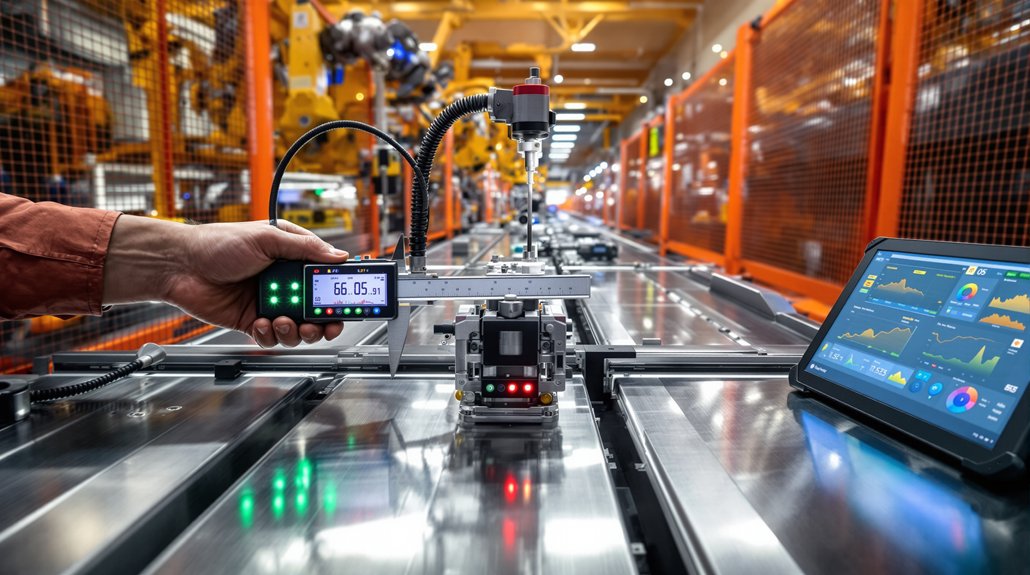
Start by identifying tasks where AI errors carry significant consequences – financial transactions, personal data handling, or decisions requiring ethical judgement. Establish tiered decision-making boundaries: let AI handle low-risk routine tasks autonomously, require alerts for medium-risk scenarios, and mandate human approval for high-stakes situations. Implement confidence thresholds that trigger human review when AI certainty drops, track accuracy through validation testing and error logs, and create response teams empowered to override systems without delays. Calculate your quality control costs against automation ROI by measuring monitoring expenses versus time saved and errors prevented, then scale guardrails dynamically as your system grows. The framework below reveals exactly how to build each layer.
Identify Which Tasks Need AI Automation Guardrails

How do you determine which automated processes require protective measures? Start by evaluating tasks where errors create significant consequences. You’ll need guardrails for automation handling financial transactions, personal data, or decision-making that affects people’s lives and opportunities.
Focus on processes with high variability or unpredictable inputs. AI systems managing customer communications, content moderation, or resource allocation deserve scrutiny because they’re interpreting nuanced situations.
When automation interprets nuanced situations with unpredictable inputs, protective measures aren’t optional – they’re essential.
Prioritise tasks requiring human judgement, empathy, or ethical considerations. Automation shouldn’t operate unchecked when making hiring decisions, approving loans, or triaging support requests.
Assess your system’s opacity. If you can’t explain how it reaches conclusions, you’re flying blind. Complex models processing medical diagnoses, legal documents, or safety-critical functions demand robust oversight mechanisms that preserve human agency.
Set Clear Boundaries for AI Decision-Making Authority
Once you’ve identified which tasks need guardrails, define exactly what your AI can decide independently and what requires human approval. Create a tiered decision-making framework that specifies thresholds and conditions. For low-risk, routine decisions, grant full autonomy. For medium-risk scenarios, implement automatic alerts while allowing AI execution. For high-stakes situations, mandate human verification before action.
Document these boundaries explicitly in your system architecture. Specify dollar amounts, customer impact levels, or operational risks that trigger escalation. You’ll eliminate bottlenecks while preventing catastrophic errors.
Test your boundaries rigorously. Run simulations that challenge edge cases and validate your thresholds align with actual risk levels. Adjust authority levels as your AI demonstrates reliability, expanding freedom where it’s earned and tightening control where vulnerabilities emerge.
Create Approval Steps for High-Risk AI Decisions
When your AI system encounters high-stakes decisions – those involving significant financial commitments, legal implications, or customer welfare – you need structured approval workflows that prevent disasters without creating bureaucratic gridlock.
Design tiered authorisation levels based on actual risk, not organisational politics. Here’s a framework that balances speed with safety:
| Risk Level | Decision Type | Required Approval |
|---|---|---|
| Low | Routine operations under $1K | AI autonomous |
| Medium | Customer refunds $1K-$10K | Manager review within 4 hours |
| High | Contract modifications, $10K+ | Director + legal sign-off |
| Critical | Data privacy, regulatory compliance | C-suite approval required |
You’ll maintain operational freedom while catching potential catastrophes. The key is making approval thresholds explicit, measurable, and adaptable as your system proves reliability.
Design Human Review Checkpoints Based on Risk Thresholds

Don’t let your system become a bottleneck. Configure thresholds that escalate based on accumulated risk, not individual transactions. If your automation processes 10,000 decisions daily, you can’t review everything – nor should you. Focus human attention where judgement genuinely matters.
Test your thresholds against historical data. Adjust them quarterly. The goal isn’t zero risk – it’s intelligent allocation of human expertise where it creates actual value.
Track AI Accuracy With Validation Testing and Error Logs
You can’t improve what you don’t measure, so tracking your AI’s accuracy through validation testing and error logs is essential. Start by implementing real-time monitoring systems that catch issues as they happen, then establish baseline accuracy metrics to define what “good” performance looks like for your specific use case. Automate error detection protocols to flag anomalies and patterns that signal when your AI is drifting from acceptable performance standards.
Implement Real-Time Monitoring Systems
How can you guarantee your automation system maintains peak performance once it’s deployed? Real-time monitoring systems provide continuous oversight, detecting issues before they escalate into costly failures. Instal dashboards that track key metrics like processing speed, error rates, and output quality. Set automated alerts that notify you when performance drifts outside acceptable parameters.
You’ll need monitoring tools that capture system behaviour across all operational layers. Track CPU usage, memory consumption, and API response times alongside business metrics. This dual approach reveals whether technical issues are impacting results.
Configure your monitors to flag anomalies immediately. When errors occur, you’ll receive instant notifications with diagnostic data, enabling swift intervention. Real-time visibility transforms reactive troubleshooting into proactive system management, keeping your automation reliable and effective.
Establish Baseline Accuracy Metrics
Before deploying any AI-powered automation, you’ll need to establish clear baseline accuracy metrics that define acceptable performance levels. Start by running validation tests against known datasets where you’ve already verified the correct outputs. Document your system’s current error rates, processing times, and decision-making patterns – these become your benchmarks.
Track every failure through detailed error logs that capture what went wrong and when. Don’t accept vague performance indicators; demand specific numbers like 95% accuracy in classification tasks or sub-2% false positive rates. These concrete metrics give you the freedom to objectively evaluate your automation rather than relying on gut feelings or vendor promises. You’ll know immediately when performance degrades and can act decisively to maintain quality standards.
Automate Error Detection Protocols
Once you’ve defined your baseline metrics, the next step is building systems that continuously monitor for deviations without manual oversight. You’ll need automated protocols that catch errors in real-time, freeing you from constant supervision while maintaining control.

Implement these validation mechanisms:
- Set up automated testing pipelines that run quality checks after each process cycle, flagging anomalies instantly
- Create threshold alerts triggered when accuracy drops below acceptable levels, enabling rapid response
- Maintain thorough error logs that categorise failures by type, severity, and frequency for pattern analysis
- Deploy shadow testing where new automation versions run parallel to production systems, comparing outputs before full deployment
These protocols work autonomously, giving you freedom to focus on strategic improvements rather than firefighting problems.
Create AI Fallback Protocols When Automation Fails
You need to establish clear trigger points that automatically escalate issues when your AI system encounters errors it can’t resolve. Set specific thresholds – such as confidence scores below 70%, repeated failures on similar tasks, or unusual patterns – that immediately flag problems for human review. Designate trained response teams who can quickly assess flagged cases, override automated decisions, and implement manual workarounds while your technical team investigates root causes.
Define Escalation Trigger Points
When automation encounters scenarios beyond its programmed capabilities, your system needs predefined trigger points that seamlessly transfer control to human operators. You’ll break free from costly errors by establishing clear boundaries where machine autonomy ends and human judgement begins.
Set these critical escalation triggers:
- Confidence thresholds – When your AI’s certainty drops below predetermined levels, route decisions to human review rather than forcing automated guesses
- Pattern anomalies – Flag transactions or behaviours that deviate markedly from established norms for immediate human assessment
- High-stakes decisions – Automatically escalate choices involving financial, legal, or reputational risks beyond acceptable parameters
- Cascading failures – Detect when multiple automation components fail simultaneously, triggering full system handoff
These triggers empower you to maintain control while maximising automation’s benefits.
Human Intervention Response Teams
Effective fallback protocols require dedicated response teams trained to intercept automation failures at precisely the moments your escalation triggers activate. You’ll need specialists who understand both your automation’s architecture and your business objectives – people who can make judgement calls when algorithms can’t.
Structure your teams with clear ownership zones. Assign primary responders for each automation workflow, ensuring they’re empowered to override systems without bureaucratic delays. Create decision matrices that guide rapid triage: what requires immediate manual intervention versus what can wait for systematic fixes.
Don’t trap your teams in reactive loops. Build their capacity to identify patterns in failures, feeding insights back to improve your automation. This transforms interventions from emergency patches into strategic learning opportunities that strengthen your entire system.
Find the Right Speed-vs-Quality Balance
As automation systems evolve, organisations face a critical tension between processing speed and output quality. You’ll need to calibrate this balance based on your specific context and risk tolerance. Break free from the false choice between efficiency and excellence – the right guardrails let you achieve both.
Consider these strategic approaches:
- Implement tiered processing speeds where high-stakes outputs receive thorough validation while routine tasks move quickly
- Deploy adaptive throttling that automatically slows processing when error rates spike above acceptable thresholds
- Create quality checkpoints at critical junctures rather than blanket reviewing everything
- Establish clear quality metrics that define acceptable trade-offs between velocity and precision
Your goal isn’t perfection – it’s sustainable performance that serves your mission without compromising integrity.
Calculate Quality Control Costs Against Automation ROI

Speed and quality decisions mean nothing if they bankrupt your automation initiative. You’ll need to quantify what quality controls actually cost versus the value they protect. Track monitoring tool licences, testing infrastructure, human oversight hours, and error remediation expenses. Then measure these against your automation’s return: time saved, accuracy improvements, and errors prevented.
Don’t let quality controls consume your efficiency gains. If your guardrails cost more than the mistakes they prevent, you’re building a cage, not freedom. Calculate your acceptable error rate based on real business impact, not fear. A 99% accuracy rate might deliver better ROI than 99.9% when you factor in the premium you’d pay for that extra precision. Run the numbers ruthlessly and choose liberation over perfection.
Scale AI Guardrails as Automation Grows
Your automation system won’t maintain the same guardrail requirements at 10 processes versus 1,000. You’ll need dynamic guardrails that evolve alongside your expanding operations. As you scale, rigid controls become bottlenecks that strangle innovation.
Design guardrails that adapt automatically:
- Implement tiered validation protocols that adjust based on process volume and complexity
- Deploy distributed monitoring systems that prevent single points of failure as you expand
- Establish automated exception handling that routes anomalies to appropriate review levels
- Create feedback loops that refine guardrail parameters using real-world performance data
You’re building infrastructure for freedom, not another cage. Smart guardrails scale horizontally, protecting quality without requiring proportional oversight resources. This means you’ll maintain control while releasing your automation’s full potential.