
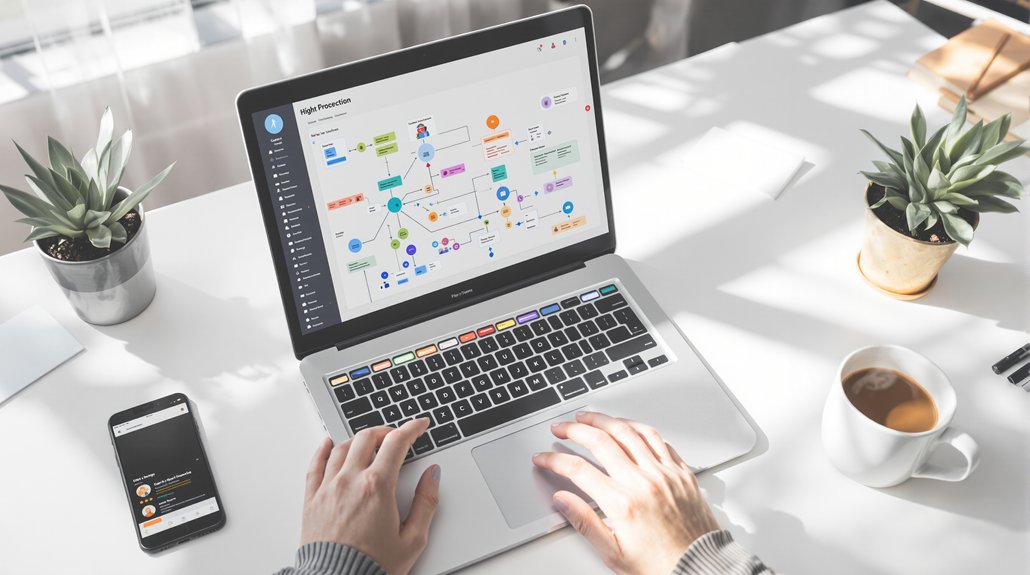
Marketing automation is software that handles your repetitive marketing tasks – like sending emails, posting on social media, and tracking customer interactions – without manual effort. You’ll set up workflows once, then they’ll run automatically, freeing you to focus on strategy and growth. It’s essential for staying competitive since your rivals are already using it to capture leads faster. With plans starting at $10-50/month, you can access tools that save over 10 hours weekly while delivering personalised messages to prospects around the clock. Below, you’ll discover exactly which tasks to automate first and how to avoid costly mistakes.
What Marketing Automation Means for Small Businesses

When you’re running a small business, marketing automation means using software to handle repetitive marketing tasks that would otherwise consume hours of your day. It frees you from manually sending emails, posting on social media, or tracking customer interactions. Instead, you’ll set up workflows once, and the system runs them automatically.
This technology liberates you from the grind of routine tasks so you can focus on strategy and growth. You’ll send personalised messages to customers at exactly the right moment without lifting a finger. Marketing automation transforms how you connect with your audience, turning time-consuming processes into streamlined operations. It’s about reclaiming your schedule while maintaining consistent, professional communication that drives results.
Why Your Small Business Needs Marketing Automation Now
Your competitors are already capturing leads while you sleep, nurturing prospects automatically, and converting customers with perfectly timed messages. Meanwhile, you’re drowning in repetitive tasks that drain your time and energy.
Marketing automation breaks these chains. It eliminates manual email sends, social media posts, and follow-up reminders that keep you tethered to your desk. You’ll reclaim hours each week to focus on strategy and growth.
Stop drowning in repetitive tasks and reclaim your time – automation frees you to focus on what truly drives growth.
The technology isn’t just for enterprises anymore. Affordable platforms now give small businesses the same advantages once reserved for corporations with massive budgets.
Every day without automation means lost opportunities. Leads slip through cracks. Customers forget about you. Revenue walks out the door.
The choice is clear: automate now or watch competitors leave you behind.
5 High-Impact Marketing Tasks to Automate First

Start with email sequences that welcome new subscribers and nurture them toward their first purchase. You’ll immediately free up hours while converting leads consistently. Next, automate your social media posting to maintain presence without daily manual effort. Set up abandoned cart emails to recover lost sales automatically – they’re proven revenue generators that work while you sleep.
Automate lead scoring so you’ll know exactly when prospects are ready to buy. Add appointment scheduling tools to eliminate phone tag and calendar chaos. Finally, implement automated follow-up sequences after purchases to drive reviews and repeat business. These tasks deliver maximum ROI with minimal setup, liberating you from repetitive work. You’ll reclaim time for strategy and growth while your automation handles execution flawlessly.
Email Sequences That Run While You Sleep
You can set up automated email sequences that nurture leads and recover lost sales without lifting a finger once they’re configured. Welcome series greet new subscribers with targeted messages that build trust and introduce your offerings, while abandoned cart emails remind potential customers to complete their purchases. These sequences work around the clock, engaging prospects at critical moments in their buying journey when manual follow-up would be impossible to maintain consistently.
Welcome Series Best Practises
When someone subscribes to your email list, the clock starts ticking on a critical window – you’ve got their attention right now, but that interest won’t last forever. Your welcome series needs to deliver value immediately while building trust automatically.
Send your first email within minutes of signup. Deliver whatever you promised – your lead magnet, discount code, or free resource. No delays.
Email two arrives 2-3 days later, sharing your story and what makes you different. Email three introduces your best content or products. Keep it to 3-5 emails total.
Each message should have one clear purpose and one call-to-action. You’re establishing the relationship that’ll free you from constantly chasing cold leads. Set it up once, and it works forever.
Abandoned Cart Recovery Tactics
While welcome emails capture new subscribers, another automation works quietly in the background recovering revenue you’ve already earned. Abandoned cart sequences trigger when customers add products but don’t complete checkout – automatically sending targeted reminders that bring them back.
Your first email should deploy within one hour, catching shoppers while they’re still interested. Include product images, clear pricing, and a direct checkout link. Send a second message after 24 hours, addressing common purchase hesitations like shipping costs or return policies. Your third email, sent at 48-72 hours, creates urgency with limited-time offers or scarcity messaging.
This automation runs continuously, converting hesitant browsers into buyers without your intervention. You’re reclaiming lost sales while focusing energy on growth that matters.
Lead Follow-Up That Converts Prospects to Customers

Because most leads aren’t ready to buy immediately, your follow-up strategy determines whether prospects eventually become customers or drift away to competitors.
Marketing automation liberates you from manual tracking by sending perfectly timed messages based on prospect behaviour. When someone downloads your guide, they’ll automatically receive relevant content that addresses their specific pain points – no spreadsheets required.
You’ll nurture leads through personalised email sequences that adapt to their engagement. If they open your pricing email, automation triggers a case study. If they ignore it, they’ll receive educational content instead.
This targeted approach converts 50% more prospects than generic follow-ups. You’re free to focus on strategy while automation handles the repetitive work, ensuring no opportunity slips through the cracks.
Social Media Scheduling Across Multiple Platforms
Managing separate social media accounts drains hours from your week as you log in, compose posts, find images, and publish content across Facebook, LinkedIn, Instagram, and Twitter. Marketing automation liberates you from this repetitive cycle.
With scheduling tools, you’ll create a week’s worth of posts in one focused session. Write your content, upload images, and queue everything to publish automatically at ideal times. The software distributes your message across all platforms simultaneously, eliminating redundant work.
You’ll maintain consistent visibility without constant platform-hopping. Schedule posts during your productive hours, then let automation handle publication while you focus on revenue-generating activities.
Analytics dashboards show which content resonates, so you’ll refine your strategy without checking multiple apps. This streamlined approach transforms social media from a time-consuming burden into an efficient growth channel.
What Marketing Automation Actually Costs Small Businesses

You’ve seen the benefits, but pricing determines whether automation fits your budget.
Most platforms use tiered pricing based on contacts and features:
- Entry-level plans ($10-50/month): Basic email automation, simple workflows, and limited contacts – perfect when you’re starting out
- Mid-tier plans ($50-150/month): Advanced segmentation, multi-channel campaigns, and CRM integration for growing operations
- Enterprise plans ($150+/month): Unlimited contacts, AI features, and dedicated support – overkill unless you’re scaling rapidly
You’ll break free from expensive agency fees while gaining control. Many providers offer free trials, letting you test-drive before committing. Calculate your time savings against monthly costs – if automation reclaims 10+ hours weekly, you’re investing in freedom, not just software.
The Right Marketing Automation Platform for Your Budget
You’ll find marketing automation platforms ranging from completely free to several hundred dollars per month, and choosing the right one starts with understanding what you actually need versus what sounds impressive. Free platforms like HubSpot’s limited tier or Mailchimp’s basic plan work well if you’re just starting out, but they’ll restrict your contact lists, email volume, and advanced features. Before you commit to any platform, identify which features are essential for your specific business goals – whether that’s email sequences, lead scoring, CRM integration, or landing page builders.
Free vs Paid Options
Choosing between free and paid marketing automation tools often comes down to your business’s size, technical expertise, and growth trajectory. Free platforms let you break into automation without financial commitment, though they’ll limit your contacts, features, and integrations.
Consider these decision factors:
- Contact volume – Free plans typically cap at 500-2,000 contacts, while paid versions scale infinitely
- Advanced features – Paid tools activate A/B testing, behavioural triggers, and predictive analytics that drive real results
- Support access – You’ll get priority assistance with paid plans versus community forums alone
Start free to learn the ropes, then upgrade when you’re ready to scale. Don’t let limited budgets trap you – many platforms offer affordable mid-tier options that deliver enterprise-level automation without the enterprise price tag.
Essential Features to Consider
Before you compare pricing tiers, map out which automation features will actually move the needle for your business. You don’t need every bell and whistle – focus on what frees up your time.
Email sequences are non-negotiable. They’ll nurture leads while you’re building your business. Look for drag-and-drop builders that let you create workflows without coding knowledge.
Contact segmentation separates casual browsers from serious buyers, so you’re sending relevant messages to the right people. CRM integration keeps your customer data synchronised across platforms, eliminating double-entry drudgework.
Analytics dashboards show what’s working and what’s wasting your resources. You need clear metrics, not vanity numbers.
Landing page builders and form creators complete your automation stack. Choose platforms offering these core features before considering advanced capabilities you might never use.
Start Here: 3 Simple Automations You Can Set Up Today

Three automations can transform your small business operations without requiring technical expertise or draining your budget.
1. Welcome Email Sequence
Set up an automated series that greets new subscribers, introduces your brand, and delivers immediate value. You’ll capture leads while you sleep and build relationships from day one.
2. Abandoned Cart Recovery
Automatically remind customers about items they’ve left behind. This simple trigger recovers lost revenue and brings shoppers back to complete their purchases.
3. Birthday or Anniversary Messages
Schedule personalised emails that celebrate your customers’ special moments. You’ll strengthen loyalty and drive repeat purchases without manual effort.
These foundational automations free you from repetitive tasks, letting you focus on growing your business instead of managing endless spreadsheets and reminders.
How to Prove Your Marketing Automation Is Working
You’ve set up your marketing automation, but now you need to demonstrate it’s actually benefiting your business. The proof lies in tracking key performance metrics like email open rates, click-through rates, and conversion percentages that show how prospects engage with your automated campaigns. Beyond these activity metrics, you must monitor your return on investment by calculating how much revenue your automation generates compared to what you’re spending on the platform and implementation.
Track Key Performance Metrics
While implementing marketing automation feels like an achievement, the real work begins when you need to demonstrate its value to stakeholders. You’ll need concrete evidence that your investment delivers results.
Focus on metrics that matter:
- Conversion rates – Track how many leads progress through your funnel and become customers
- Time savings – Quantify hours reclaimed from manual tasks you’ve automated
- Revenue attribution – Connect automated campaigns directly to dollars earned
Don’t let vanity metrics distract you. Open rates and follower counts won’t prove ROI. Instead, measure what impacts your bottom line. Pull reports monthly, compare performance against your baseline, and adjust campaigns based on data. When you can show increased revenue with decreased effort, you’ve proven automation’s worth.
Monitor Return on Investment
Tracking metrics tells you what’s happening, but calculating ROI proves whether your automation investment makes financial sense. Compare your automation costs – software subscriptions, setup time, and training – against the revenue it generates through increased conversions, recovered abandoned carts, and repeat purchases.
You’ll want to measure both direct and indirect returns. Direct ROI includes sales from automated email campaigns and lead nurturing sequences. Indirect returns encompass time saved, reduced manual errors, and freed-up resources you can redirect toward growth activities.
Set a baseline before implementing automation, then measure quarterly. If you’re spending $200 monthly but generating $1,000 in added revenue, that’s a 5x return. This concrete evidence justifies your investment and guides future automation decisions.
7 Automation Mistakes That Waste Time and Money

Many small businesses plunge into marketing automation expecting instant results, only to find themselves buried in unnecessary complexity and spiralling costs. You’re wasting resources when you automate without strategy.
Common pitfalls that’ll drain your budget:
- Over-automating personal touchpoints – Customers detect robotic interactions immediately, damaging relationships you’ve worked hard to build.
- Ignoring data quality – Feeding automation tools with outdated contact lists creates embarrassing mistakes and compliance issues.
- Setting and forgetting campaigns – Automation isn’t autopilot. Without regular optimisation, you’re sending irrelevant messages that drive unsubscribes.
Break free from these traps by starting small, testing rigorously, and maintaining human oversight. Your automation should amplify your marketing efforts, not replace thoughtful customer engagement.
When to Automate vs. When to Stay Personal
The biggest automation decision you’ll face isn’t about which tools to buy – it’s about drawing the line between efficiency and authenticity.
| Situation | Automate | Stay Personal |
|---|---|---|
| Welcome emails | ✓ | |
| Customer complaints | ✓ | |
| Newsletter delivery | ✓ | |
| High-value sales | ✓ |
You’ll break free from busywork by automating repetitive tasks that don’t require human judgement. But when someone’s frustrated, confused, or spending significant money, that’s your moment to show up personally.
The rule: automate the predictable, personalise the meaningful. Your customers won’t remember your perfectly timed drip campaign, but they’ll absolutely remember whether you treated them like a ticket number or a human being.
Scaling Your Marketing Without Hiring More People

Once you’ve sorted out what deserves automation and what demands your personal touch, you’ll hit a different wall: growth. Your marketing needs expand, but you can’t afford another hire. That’s where automation becomes your force multiplier.
You’ll scale effectively by focusing on three areas:
- Lead nurturing sequences that run 24/7, converting prospects while you sleep
- Social media scheduling that maintains your presence without daily manual posting
- Email segmentation that delivers personalised messages to thousands simultaneously
This isn’t about replacing human creativity – it’s about freeing yourself from repetitive tasks. You’ll reclaim hours weekly, redirect energy toward strategy, and grow your reach exponentially. One person with smart automation outperforms entire teams stuck in manual mode.